Back
Back All articles
When we sat down with Romney Taylor, VP of Marketing at Kuda, the conversation quickly moved to the gap between knowing your customer on paper and actually understanding them as people. Since its launch in 2019 as Nigeria’s first fully digital bank, Kuda has built its reputation on disruption, like removing fees, eliminating large branch networks, and redefining convenience. But as the company scaled, it became clear that growth would depend not just on access but on insight.
According to Taylor, that meant going deeper than traditional metrics. While Kuda had strong demographic and behavioral data, it lacked the human layer, that is, the context behind decisions, the lived experiences shaping financial habits, and the nuances of everyday life in Nigeria. Bridging that gap required a more intentional approach to research, one that combined internal data with real conversations and fresh external perspectives to build a clearer, more human picture of its customers.
That journey hasn’t been without its challenges, from finding the right participants to conducting meaningful, unbiased conversations, but it has fundamentally reshaped how Kuda listens, learns, and grows. In the Q&A below, Romney shares how this shift is influencing everything from marketing to product decisions and why understanding the person behind the data has become non-negotiable.
What was your top priority when you joined Kuda, and how did research fit into that?
The number one priority was understanding the customer. Nigerian people's needs and pain points around banking, money, and life in Nigeria. I wanted to build a rich picture by combining what we already knew internally with what we could learn directly from people. That meant starting with our own data, then talking to existing customers, and then widening out to people who weren't using Kuda yet to really nail our ideal customer profile.
What challenges were you running into before bringing in an external research partner?
Recruitment was the first major challenge, especially finding people who fit the ICP and who were actually willing to participate. People's time is valuable. But beyond that, once you have the right people in a room, you need the right skills to get the most out of the conversation. Conducting a one-hour qualitative interview well is genuinely hard. Asking the right questions and guiding things naturally, is a craft. And for me personally, Nigeria is a new market. I wanted research that came without any internal agenda or bias attached to it. An objective partner felt essential.
What did qualitative research add that you couldn't get from your existing data?
The first version of Kuda’s ICP was “cold” - it was made up of demographics, psychographics, and other important data. It told us who our customers were on paper. What the qualitative research did was put faces, names and stories to those profiles. Suddenly we knew what they do on a Saturday afternoon, what devices they use to manage their money, and what they actually care about. It made the profiles human, and that changes everything for how we think about product, content, and partnerships.
And what about the quantitative side? How has that been valuable?
The quantitative work has been crucial for brand tracking and getting a consistent pulse check on how people perceive Kuda. How many people are aware of us? Where did they last hear about us? How do they feel about the company? That kind of data lets us track whether our marketing is actually moving the needle. It's accountability in a very direct sense.
Has the research changed how teams across the company operate?
Absolutely. One of the most concrete outcomes is that we now have all of our customer insight centralized in one place. When any team - whether they’re building a new feature, creating content, or evaluating a partnership - needs to make a decision, there's a single source of truth they can turn to. It keeps everyone grounded. It stops teams from chasing the wrong things. That alignment across the organization has been one of the biggest practical wins.
Were there any surprises along the way?
There were insights confirmed that we hadn't necessarily expected to be confirmed, which is its own kind of valuable. Sometimes you run research hoping to discover something new, and what you actually get is the confidence that what you believed was right. That matters for decision-making too. And on a more personal level, some of the most interesting conversations happened with members of the research team themselves, who happened to fit our ICP. That added an entirely unplanned but genuinely insightful dimension to the collaboration.
Would you recommend this approach to other marketing leaders?
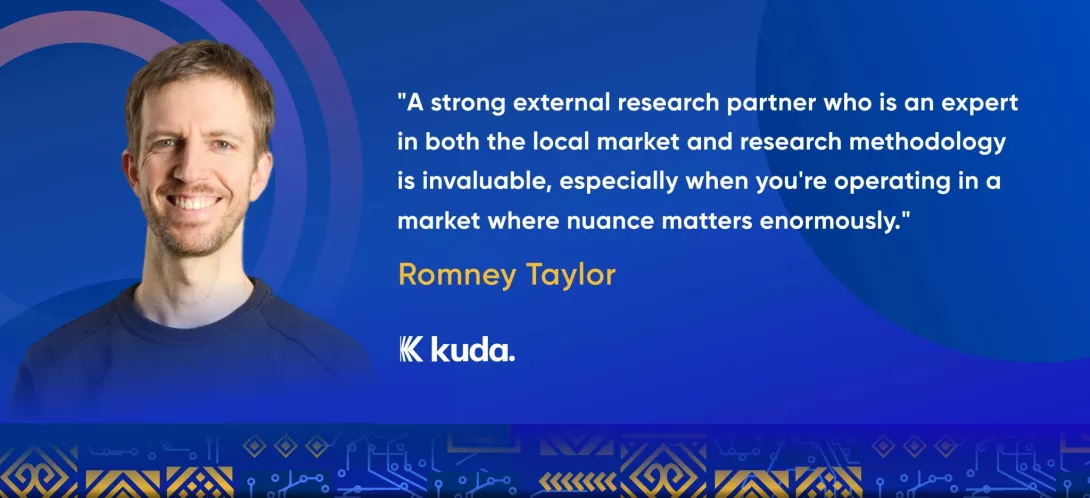
For sure. A strong external research partner who is an expert in both the local market and research methodology is invaluable, especially when you're operating in a market where nuance matters enormously, as it does in Nigeria. The professionalism, the willingness to go the extra mile, and the quality of the outputs all translate directly into better decisions. We’ll absolutely be doing more of this.